To build an ocean-engaged society, empowering people to better understand, value, and care for the ocean.
We serve as a:
Catalyst: innovating and influencing high impact public ocean engagement
Connector: building collaboration and convening exchange within the ocean sector
Enabler: supporting and strengthening capacity within the ocean sector
Accelerator: sharing and amplifying what works
Our Theory of Change
Our Story
COLC grew out of a small 40-person informal consultation and national workshop, as part of the Ocean Research in Canada Alliance Conference in April 2018. These events led to the creation of A Development Plan: Building a National Ocean Literacy Strategy in June 2018. COLC formally launched in September 2018 at the Oceans Inspiration Expo in Halifax, Nova Scotia, as part of the G7 Ministerial Meeting on Working Together on Climate Change, Oceans, and Clean Energy.
COLC’s initial project was to lead a Canada-wide research initiative to examine how ocean literacy is understood and practiced across the country. Led by an all-women research team (Diz Glithero, Sarah MacNeil, Julia Ostertag, Lilia Yumagulova, Carie Hoover, Justine Ammendolia, Noemie Roy, Shannon Monk), COLC published the Understanding Ocean Literacy in Canada study reports in June 2020, establishing the first baseline of ocean literacy in Canada. These findings guided the development of Land, Water, Ocean, Us: A Canadian Ocean Literacy Strategy (March 2021), making Canada the first country in the world with a national strategy.
COLC has operated as an independent national project office with administrative headquarters at the Canadian Museum of Nature (2018-2021), Ocean Networks Canada at the University of Victoria (2021-2024), and Ocean Frontier Institute at Dalhousie University (2024-present).
Diz is an award-winning educator, social science researcher, and leader focused on environmental conservation, public engagement, and collaborative action. She connects people, ideas, and efforts to generate positive impact.
Roxanne is a project and administrative professional with a background in Conservation & Land Management and Travel. They excel at creating efficiencies, problem solving and leveraging technology.
Meg is a science communicator with a background in Zoology, animal behaviour, and environmental visual communication. She is passionate about engaging the public through visual media and creating connections to local waterways.
Jen is a social science researcher with a background in natural and social sciences. Her work engages participatory methods that invite critical perspectives, place-based narratives, and creative solutions to shared challenges.
Iwinet is a strategic marketer with a background in public relations and marketing. She specializes in simplifying complex messages for greater impact and is passionate about ethical, purpose-driven marketing strategies.
Iwinet Stewart Digital Marketer & Social Media Specialist
(he/him)
Ty is a science communicator with a background in conservation science, land stewardship, and environmental outreach. He is passionate about showcasing the intricacy and splendour of natural ecosystems in creative ways to inspire people to help protect them.
Collaboration drives positive impact. Partnerships have been central to our work since the beginning. Our work would not be possible without the active engagement of the following core partners:
As of late 2025, we have collaborated with over 670 unique partner organizations. These include activation partners, event hosts, research partners and funders. Our partners represent a range of sectors, including: Non-Government, Education, Arts & Culture, Research, Community, Industry, Government, and Media. Ocean Week Canada, our flagship initiative, attracts the largest share of partners (85%).
Our Logo
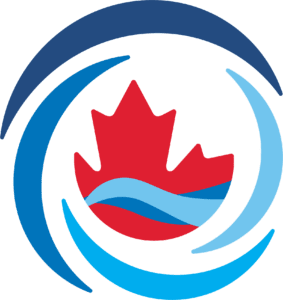
The four blue arcs encircling a red maple leaf represent Canada’s three ocean coastlines — Atlantic, Arctic, Pacific — as well as the extensive inland coastline stretching along the Great Lakes and St. Lawrence River.
The largest arc at the top of the logo represents the Arctic coastline, which accounts for 50% of Canada’s overall coastline. The braided stream of blue running through the centre of the maple leaf is in recognition of the complex, interconnected freshwater systems that form the heart of inland Canada, and through which every Canadian, regardless of where they live, is connected to the ocean.